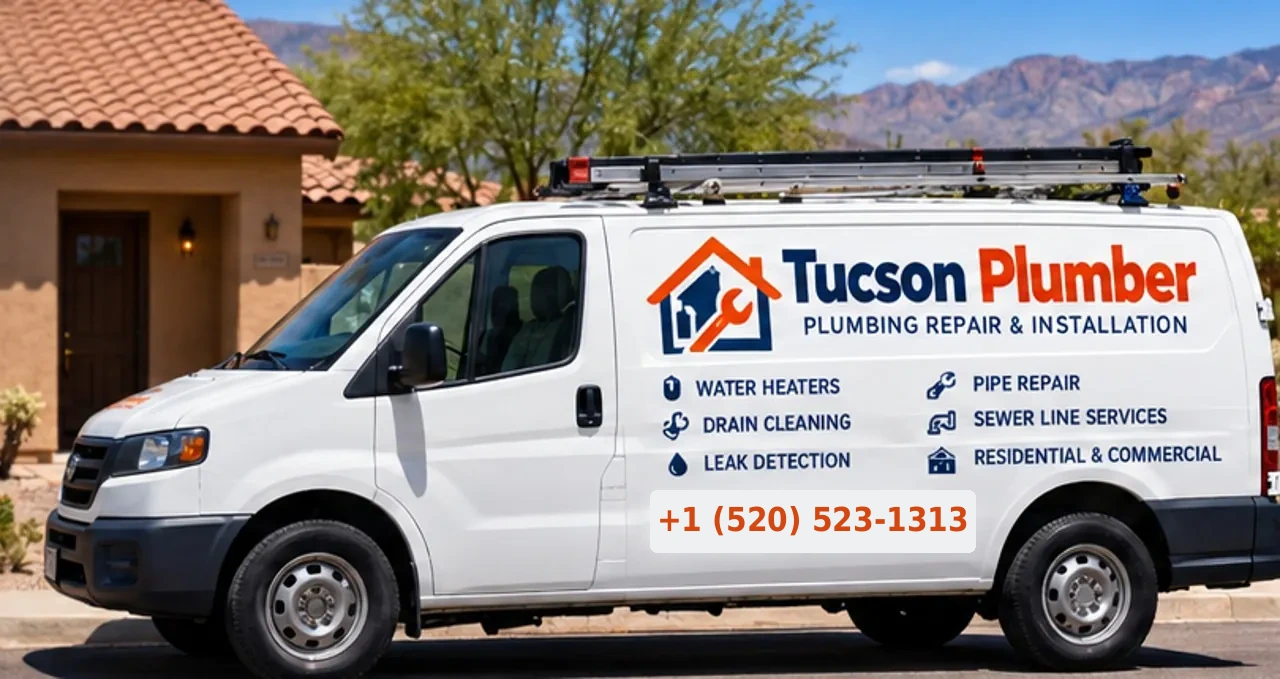
Your Local Tucson Plumbing Experts
Reliable plumbing repair, installation, and drain services for homes and businesses across Tucson. From small leaks to major repairs, we help keep your plumbing system working properly.
A plumbing problem rarely announces itself politely. It shows up as a water stain spreading across the ceiling, a shower that takes five minutes to get hot, or a drain that starts gurgling on a Saturday night. Tucson Plumber is a local plumbing company serving homes and businesses across the Tucson metro — and our work starts with figuring out exactly what's wrong, then fixing it properly.
We handle the full range of plumbing work: repairs, drain cleaning, sewer line work, water heaters, pipe repair and repiping, leak detection, and water line replacement for both residential and commercial properties. From mid-century ranches in central Tucson to newer builds in Vail and Marana, we've seen it all.
Have a plumbing problem right now? Call +1 (520) 523-1313 — tell us what's happening and we'll talk through what to do next.
Explore Our Plumbing Services
Every service below has its own detailed page — pick the one that matches your problem.
Plumbing Repair
Tucson Plumber handles leak diagnosis, pipe repair, fixture leaks, valve problems, low water pressure, and drainage faults across Tucson, AZ. Call +1 (520) 523-1313.
Learn more →Emergency Plumber
Emergency plumber in Tucson, AZ for burst pipes, active leaks, sewage backups, and overflowing fixtures. Shutoff steps and triage advice. Call +1 (520) 523-1313 now.
Learn more →Drain Cleaning
Professional drain cleaning in Tucson, AZ for kitchen, bathroom, shower & floor drains. Grease, hair, and hard-water scale cleared without harsh chemicals. Call +1 (520) 523-1313.
Learn more →Sewer Line Repair
Sewer line repair in Tucson, AZ: root intrusion, cracked & collapsed pipe, camera inspection, excavation, replacement & trenchless options. Call +1 (520) 523-1313.
Learn more →Water Heater Repair
Water heater repair in Tucson, AZ for no hot water, rumbling tanks, leaks, and rusty water. Tucson Plumber diagnoses gas and electric units and fixes what can be fixed — call +1 (520) 523-1313.
Learn more →Water Heater Replacement
Water heater replacement in Tucson, AZ — tank vs tankless, sizing, gas and electric options. Tucson Plumber helps you decide when repair isn't enough. Call +1 (520) 523-1313.
Learn more →Water Heater Installation
Water heater installation in Tucson, AZ for new builds, additions, casitas, and first-time setups. Sizing, equipment selection, venting, and code-compliant install. Call +1 (520) 523-1313.
Learn more →Water Leak Detection
Water leak detection in Tucson, AZ — hidden leaks, slab leaks, high water bills, damp walls. Tucson Plumber pinpoints leaks with professional equipment. Call +1 (520) 523-1313.
Learn more →Pipe Repair
Pipe repair in Tucson, AZ for pinhole leaks, cracked pipes, corrosion, and failed fittings. Tucson Plumber repairs accessible and concealed piping — call +1 (520) 523-1313.
Learn more →Repiping
Repiping in Tucson, AZ: whole-home and partial pipe replacement in copper or PEX for aging galvanized, corroded, or leaking systems. Call Tucson Plumber at +1 (520) 523-1313.
Learn more →Toilet Repair
Toilet repair in Tucson, AZ for running toilets, weak flushing, base leaks, clogs, and tank problems. Tucson Plumber diagnoses and fixes it right — call +1 (520) 523-1313.
Learn more →Faucet and Sink Repair
Faucet repair in Tucson, AZ for drips, worn cartridges, low flow from hard-water scale, and under-sink leaks. Tucson Plumber fixes faucets and sinks — call +1 (520) 523-1313.
Learn more →Water Line Repair
Leaking main water line in Tucson? Tucson Plumber repairs and replaces underground service lines damaged by leaks, pressure loss, and Tucson's caliche soil. Call +1 (520) 523-1313.
Learn more →Sewer Camera Inspection
See inside your sewer line before you pay for repairs. Tucson Plumber's sewer camera inspection finds roots, cracks, bellies, and blockages in Tucson sewer lines. Call +1 (520) 523-1313.
Learn more →Residential Plumbing
Whole-home plumbing service for Tucson homeowners — repairs, fixtures, water heaters, drains, and maintenance for older central Tucson homes and newer subdivisions. Call +1 (520) 523-1313.
Learn more →Commercial Plumbing
Plumbing for Tucson businesses — restrooms, drainage, water distribution, and commercial water heating with minimal disruption to your operations. Call +1 (520) 523-1313.
Learn more →Plumbing Problems We Solve in Tucson Homes and Businesses
Most calls we get fall into a handful of categories. If yours sounds familiar, we can almost certainly help:
- Leaks — dripping faucets, leaking supply lines, slab leaks under concrete floors, and water showing up where it shouldn't.
- Clogs — slow drains, recurring backups, toilets that won't flush cleanly, and main-line blockages.
- Sewer odors and backups — foul smells from drains, sewage surfacing in tubs or floor drains, and gurgling fixtures.
- Water heater failures — no hot water, lukewarm water, strange noises, or a tank leaking from the base.
- Low water pressure — a weak shower, faucets that barely trickle, or pressure that fades when more than one fixture runs.
- Corrosion — rust-colored water, pinhole leaks in copper, and flaking, crusty supply pipes.
- Moisture and dampness — musty smells, damp cabinets or walls, and unexplained mold growth near plumbing.
Many of these look alike on the surface. A weak shower could be mineral scale in the showerhead, a failing pressure regulator, or corroded pipes narrowing from the inside. That's why diagnosis comes before repair — every time.
Our Plumbing Services in Tucson
Below is an overview of the work we do. Each service has its own page with more detail on common causes and what to expect when we come out.
Plumbing Repair
General plumbing repair covers the day-to-day failures that make a home or business hard to live in: dripping faucets, failed supply valves and angle stops, leaking P-traps, and worn connections. We fix the immediate problem and check whether it's a symptom of something bigger, like excessive water pressure or pipes corroding from the inside.
Drain Cleaning
Slow or stopped drains are one of the most common reasons people look for a plumber in Tucson AZ. Our drain cleaning service clears kitchen lines clogged with grease, bathroom lines choked with hair and soap, and main sewer lines blocked by roots or buildup — using professional cable equipment and hydro jetting where appropriate. If a clog keeps returning, a camera inspection usually reveals why.
Sewer Line Repair
When wastewater backs up into a tub or floor drain, the problem is past the DIY stage. We provide sewer line repair for cracked, bellied, root-invaded, and collapsed lines — starting with a camera inspection so you can see exactly what's wrong underground before any digging begins. Trenchless options may be possible depending on your line's condition and layout.
Water Heater Repair and Replacement
Tucson's hard water is rough on water heaters, and scale-related failures are something we see constantly. We offer water heater repair for thermostats, heating elements, and ignition issues, plus full water heater replacement and new installation when a tank is past saving. We'll help you weigh tank vs. tankless based on your household's actual hot-water use — not a one-size-fits-all pitch.
Pipe Repair and Repiping
A single leaking section can usually be cut out and replaced — that's pipe repair. But a system full of pinhole leaks and failing joints needs a bigger conversation. Whole-home repiping replaces aging supply lines with modern materials, often rerouted through walls or attics to get vulnerable lines out from under the slab for good.
Leak Detection
Not every leak is visible. Our leak detection service uses acoustic listening equipment, thermal imaging, and pressure testing to pinpoint slab leaks, in-wall leaks, and underground supply leaks without tearing your home apart. The classic tip-off is a water bill that climbs while your usage hasn't changed.
Toilet, Faucet, and Sink Repair
Running toilets, phantom flushes, weak flushes, dripping faucets, and slow-draining sinks all land here. We handle toilet repair — fill valves, flappers, seals, and full replacement — along with faucet and sink repair for cartridges, supply lines, and drain assemblies. Small jobs, but a toilet that runs all day wastes an astonishing amount of water in a desert city.
Water Line Repair
The line from the meter to your home is your responsibility, not the utility's — and when it fails, you can lose a lot of water fast. Our water line repair service locates and fixes leaks in the main supply and replaces lines that have reached the end of their life. A persistently damp patch in the yard or a sudden whole-house pressure drop are the usual early warnings.
Emergency Plumbing
Burst pipes, major leaks, sewage backups, and water heaters dumping water on the floor can't wait. If you're facing an emergency plumbing situation, call +1 (520) 523-1313 right away — we'll talk you through immediate steps like shutting off your main valve and get help headed your way.
Residential Plumbing
From single repair visits to whole-home repipes and remodel rough-ins, our residential plumbing work covers houses, condos, townhomes, and rental properties across the metro. We protect your floors and finishes, work around your schedule, and explain what we find in plain language.
Commercial Plumbing
Restaurants, offices, retail spaces, and multi-tenant properties put far more demand on plumbing than a typical home — and a failure costs money by the hour. Our commercial plumbing work covers high-use fixtures, grease management, restroom plumbing, and the maintenance planning that keeps a business running without surprise shutdowns.
Not sure which service fits? Describe the symptom instead — we'll figure out the right fix. Call Tucson Plumber at +1 (520) 523-1313.
Warning Signs Your Plumbing Needs a Professional
Some plumbing problems are obvious. Others whisper. Here's what to watch for — and what each sign usually points to.
Damp spots, stains, or bubbling paint
A stain on the ceiling, a warped baseboard, or bubbling paint near a bathroom often means a supply or drain line is leaking inside the structure. Water travels, so the stain is rarely directly under the leak. Drying it out without fixing the source invites a repeat performance.
A water bill that keeps climbing
If your habits haven't changed but your Tucson Water bill has, suspect a hidden leak — a running toilet, a dripping supply line, a slab leak, or a faulty irrigation tie-in. A plumber can determine whether the loss is inside the house or in the yard line.
Low or fluctuating water pressure
Pressure that fades when two fixtures run, or a shower that's gone from strong to sad, points to restriction somewhere: mineral scale, internal pipe corrosion, a failing pressure regulator, or a partially closed valve. Low pressure at one fixture and low pressure everywhere have different causes — we check both.
Slow drains and gurgling fixtures
One slow drain is usually a local clog. Multiple slow drains, gurgling when a toilet flushes, or water backing up in a tub when the washer drains suggests the main line is restricted. Act at this stage — before it becomes a full backup.
Sewer odors indoors
A sewage smell from a drain usually means a dried-out trap, a blocked vent, or a cracked drain line or wax seal. Running water in a rarely used floor drain often solves the occasional odor; a persistent smell needs investigation.
Discolored or odd-smelling water
Brown or yellow water that clears after a few seconds is often rust from aging galvanized or iron piping. A metallic taste or persistent discoloration warrants a professional look. (A rotten-egg smell only in hot water usually traces back to the water heater's anode rod — covered in our FAQs.)
Water heater warning signs
Rumbling or popping sounds, rusty water from hot taps, hot water that runs out faster than it used to, or moisture around the tank's base all signal a heater in decline. In hard-water country, these symptoms arrive sooner than many homeowners expect.
Toilets that run, rock, or won't flush right
A toilet that runs between flushes is usually a worn flapper or misadjusted fill valve — cheap parts that waste water around the clock. A toilet that rocks has a failing wax seal, which can leak sewage beneath the floor. Weak flushing can mean a partial clog, low fill level, or venting trouble.
Seeing one or more of these? Don't wait for a small symptom to become a big repair. Call +1 (520) 523-1313 and tell us what's going on — we'll help you judge how urgent it is.
Repair or Replace? How We Help You Decide
"Can this be fixed, or should I replace it?" The honest answer depends on the equipment's age, condition, and history. Here's the framework we walk through with you:
- Age. A 6-year-old water heater with a failed thermostat is a repair. A 14-year-old tank rusting at the base is a replacement candidate.
- Breakdown frequency. One failure is bad luck; three service calls in two years is a pattern — and cumulative repair costs often approach replacement cost.
- Extent of damage. One corroded pipe section is a repair. Corrosion at multiple joints, pinhole leaks in different rooms, or rust-colored water throughout the house is a system problem that spot repairs won't solve.
- Efficiency. Older water heaters and fixtures use more water and energy than current models. If you're replacing anyway, the operating savings are worth factoring in.
- Collateral risk. A water heater in a garage with a drain pan is one thing; the same unit in an interior closet above finished living space is another. When failure means major water damage, replacing on your schedule beats replacing on the leak's schedule.
We don't push replacement when repair is the sensible call, and we don't nurse along equipment that's clearly done. You get the facts and our recommendation — the decision stays yours.
How Your Plumbing Actually Works: Supply and Drainage
Every plumbing system has two halves, and knowing the difference makes symptoms much easier to interpret.
The supply side delivers pressurized fresh water into your home — from the meter, through the main shutoff and pressure regulator, then through hot and cold lines to every fixture. Everything here is under pressure, which is why supply-side leaks spray, drip continuously, and show up on your water bill.
The drainage side carries wastewater away by gravity. Drain pipes slope toward the main sewer line, vent pipes extend through the roof so water flows smoothly and sewer gases escape outside, and the U-shaped traps under sinks hold a plug of water that blocks sewer gas from entering the home. Drain problems show up as slow flow, gurgling, odors, and backups — not spraying leaks.
Most confusion comes from mixing the two up. A gurgling toilet isn't a pressure problem; it's a drainage or venting problem. A faucet that drips with everything off isn't a drain problem; it's a supply-side seal failure. When you call us, describing which half is misbehaving helps us zero in faster.
Pipe Materials Common in Tucson Homes
Tucson has homes spanning more than a century of construction, and the pipes inside them tell that story:
- Copper — long the standard for supply lines. Durable, but in aggressive water conditions it can develop pinhole leaks over time. Still a solid repipe choice.
- PEX — flexible plastic tubing that's become the go-to for modern repipes and new construction. It resists scale and corrosion, and its flexibility means fewer joints (and fewer potential leak points).
- PVC and ABS — rigid plastics used for drain, waste, and vent lines. PVC also appears in cold-water and irrigation lines, but it isn't rated for hot water — that's CPVC's job. Exposed exterior PVC degrades faster under intense desert sun and should be protected.
- CPVC — rated for hot water and found in many homes built from the 1980s onward. Serviceable, though it grows more brittle with age.
- Cast iron — heavy, quiet drain piping common in mid-century homes. Long-lived, but it eventually corrodes internally, developing rough scale that catches debris and narrows the pipe.
- Galvanized steel — zinc-coated steel used widely before the 1980s. It corrodes from the inside out: rust builds up, flow shrinks, pressure drops, and water can turn brown or taste metallic. If your central-Tucson home still has galvanized supply lines, replacement is a matter of when, not if.
- Polybutylene — gray plastic supply piping installed from the late 1970s through the mid-1990s. It reacts poorly with disinfectants in treated water, turning brittle and failing at joints and fittings. Finding it during a purchase or remodel is a strong signal to budget for repiping.
Not sure what's in your walls or under your slab? We can identify your pipe materials during any service visit — it shapes every recommendation we make.
Plumbing Problems That Are Uniquely Tucson
Plumbing is plumbing everywhere — but the desert creates a specific set of stresses. Here's what makes Tucson different, based on what we actually see in local homes.
Hard water and mineral scale
Tucson's supply blends groundwater with Colorado River water delivered through the Central Arizona Project, and it runs hard. Independent local water resources report hardness around 211 parts per million (about 12 grains per gallon) — well into the "very hard" range — with readings that vary significantly by neighborhood and season. Tucson Water itself classifies the supply as hard to very hard.
Inside your home, dissolved calcium and magnesium precipitate as scale wherever water is heated or evaporates: in water heaters, on faucet aerators and showerheads, in appliance valves, and eventually inside pipes themselves. Over the years, scale narrows waterways, insulates water heater tanks from their burners or elements (driving up energy use), and shortens appliance life. It's the biggest reason Tucson water heaters and fixtures wear out faster than the averages printed on the box suggest.
A whole-home softener or conditioner is worth considering here — but sizing and type depend on your actual hardness reading and plumbing layout. We can test your water and talk through the options honestly, including the cases where treatment isn't worth it.
Monsoon-season drainage stress
Tucson's official monsoon season runs June 15 through September 30, delivering roughly half the year's rainfall in intense, fast-moving storms — August is typically the wettest month. Roof drains, yard drains, and area drains that sat dry for nine months suddenly face inches of rain in an hour; clogged or undersized exterior drains back water up against foundations and into garages. Meanwhile, saturated soil can infiltrate aging sewer lines through cracks and bad joints. If your home has a history of monsoon-season backups or yard flooding, late spring is the time for a drain and sewer inspection — not mid-July.
Older central-Tucson homes vs. newer suburbs
Tucson's housing stock splits roughly into two plumbing eras. Central-neighborhood homes — built from the early-to-mid 1900s through the 1970s — commonly still contain galvanized steel supply lines and cast-iron drains, sometimes with polybutylene mixed in from later remodels. These systems are reaching the end of their service lives all at once, which is why repiping is such a common project in older neighborhoods.
Newer construction in Oro Valley, Marana, Vail, Sahuarita, and similar growth areas typically uses PEX supply lines and PVC/ABS drains — materials that resist the corrosion problems of the older stock. The failure modes are different and usually less systemic, though installation quality varies and hard water still scales fixtures.
Buying an older Tucson home? A plumbing inspection that identifies pipe materials is money well spent. We've seen too many buyers discover galvanized or polybutylene only after the first leak.
Slab foundations
Much of Tucson's housing sits on concrete slabs with water lines routed underneath. When an under-slab line fails — from corrosion, abrasion, or shifting soil — water escapes directly into the ground beneath your home. Warning signs include a warm spot on the floor, the sound of running water with everything off, a climbing water bill, or damp, buckling flooring.
Slab leaks are repairable, but the fix isn't always "break the floor." Rerouting a new line overhead through walls or attic space is often the better long-term answer — which is exactly what a whole-home repipe does. We evaluate both options for your situation.
Summer heat
Summer highs regularly top 100°F, and that heat reaches your plumbing. Garage-installed water heaters — the most common setup here — run in extreme ambient temperatures while hard-water sediment bakes onto tank bottoms, making burners work harder. Plastic lines expand and contract with temperature swings, stressing joints, and exposed exterior piping degrades faster under intense UV. Tucson systems simply benefit from a little more attention than the owner's manual assumes: annual water heater flushing, periodic checks of exposed piping, and keeping an eye on the anode rod.
Dealing with scale, slab leaks, or monsoon-season backups? These are the problems we see most in Tucson homes. Call +1 (520) 523-1313 to talk through yours.
How We Diagnose a Plumbing Problem
Anyone can replace a part. The skill is knowing which part — or whether the part is even the problem. Our approach on every call:
- Listen first. When did it start? Constant or intermittent? One fixture or the whole house? Hot, cold, or both? Your answers narrow the field enormously.
- Inspect visually. We look at the fixtures, visible piping, water heater, and surrounding areas before touching a tool. Many diagnoses are made with eyes and ears alone.
- Test systematically. Pressure gauges, thermal imaging, and meter tests reveal what's happening inside walls and underground. If we suspect a slab leak, we isolate sections of the system to confirm it before recommending any invasive work.
- See inside the pipes. For drain and sewer issues, a camera inspection removes the guesswork — and you'll see what we see on the monitor.
- Explain before we fix. You get a clear description of the problem, the options, and what each involves. No work starts until you understand and approve it.
Misdiagnosis is expensive: replacing a water heater won't fix lukewarm showers caused by a failing mixing valve, and snaking a drain won't fix a collapsed main line. We'd rather spend an extra twenty minutes diagnosing than sell you the wrong repair.
What Affects the Cost of Plumbing Work
We don't publish flat prices because honest pricing depends on what's actually wrong — two jobs that sound identical can differ substantially once we see them. Here's what drives cost, so you can understand any estimate you receive:
- Access. A leaking valve under a sink is quick to reach. A pipe inside a finished wall, or a sewer line under a concrete driveway, requires opening things up and putting them back.
- Material and scope. Replacing ten feet of accessible PEX is a different job than replacing corroded galvanized steel throughout a home or excavating to reach a collapsed sewer line.
- Extent of damage. A single failed joint costs less than systemic corrosion — and catching a leak early almost always costs less than repairing months of water damage.
- Permits and code requirements. Larger jobs must meet current plumbing code, which can mean upgrades to venting, valves, pans, or cleanouts that weren't required when the original work was done.
- Finish restoration. Opening a wall or slab section is half the job; patching drywall, re-tiling, or re-pouring concrete adds to the total.
- Equipment tier. A basic replacement toilet and a high-efficiency model are priced accordingly — we quote options at different tiers so you can choose.
- Timing. Work scheduled during normal hours is straightforward to price; situations that can't wait understandably cost more to address immediately.
What we promise is transparency: a clear written scope, the price before work begins, and no buried surprises. If something unexpected turns up mid-job, we stop and discuss it before proceeding.
Residential Plumbing for Tucson Property Types
Different homes stress their plumbing differently:
- Single-family homes — the full range: supply, drainage, water heaters, and the slab-leak and hard-water issues described above. Older ranch homes in central Tucson are prime candidates for repipe evaluations.
- Condos and townhomes — shared walls and stacked plumbing mean one unit's leak can become a neighbor's ceiling stain. We document what's yours, what's common area, and what the HOA owns before work begins.
- Historic and adobe homes — older neighborhoods near downtown and the university area hold some of the city's oldest plumbing, often modified piecemeal over decades. These homes reward careful diagnosis.
- Manufactured homes — different piping layouts than site-built homes, with more exposed under-home plumbing vulnerable to damage and temperature swings.
- Rental properties — landlords and property managers need fast, documented, no-drama service. We provide clear invoices and straightforward communication for remote owners.
Commercial Plumbing Considerations in Tucson
Commercial plumbing isn't just residential plumbing at a bigger scale:
- High-use fixtures. Restrooms in offices, restaurants, and retail see in a day what a home fixture sees in a month — which is why commercial-grade fixtures and maintenance schedules exist.
- Grease and food service. Grease interceptors need regular pumping and lines need periodic jetting; neglect here is the most common cause of restaurant sewer backups we see.
- Downtime costs money. A restaurant with a backed-up sewer or an office with no working restrooms cannot operate. We prioritize getting you functional, then address the root cause.
- Multi-tenant buildings. Shared drain stacks and water lines mean one tenant's problem can cascade. Coordinating access and documenting responsibility are part of the job.
- Preventive maintenance. Scheduled drain maintenance, water heater servicing, and backflow testing cost far less than emergency calls — or closing for a day. We can set up a maintenance rhythm that fits your operation.
If you manage commercial property in the Tucson area, call +1 (520) 523-1313 to discuss what your building needs.
Urgent Plumbing Situations: What to Do Right Now
Some situations need a plumber immediately; all of them benefit from the right first moves.
If water is flowing where it shouldn't (burst pipe, major leak):
- Shut off the main water valve. In most Tucson homes it's near the water meter at the property line, in a ground-level box — usually under a round or rectangular lid. Turn clockwise (a quarter-turn for ball valves) until the flow stops.
- Turn off the water heater — gas units to "pilot" or "off," electric units at the breaker — so the tank doesn't heat with no water in it.
- Open a faucet at the lowest point in the house to drain remaining pressure.
- Move valuables and cut power to areas where water nears outlets or appliances. Never step into standing water where electrical hazards may exist.
If sewage is backing up: stop using water — every flush adds to the backup. Keep people and pets away; sewage is a health hazard. Don't plunge a main-line backup aggressively; call a professional.
If you smell gas near an appliance: don't light anything or flip switches — leave the area and call your gas utility's emergency line or 911 from outside. A plumber handles the appliance side once the utility clears the scene.
If the water heater tank itself is leaking (not a fitting): shut off its cold-water supply valve and the heat source as described above. A tank leaking from its body can't be patched — it's a replacement, and catching it early is the difference between a planned swap and a flooded garage.
Find your main shutoff valve before you need it. Two minutes on a calm Saturday saves panicked minutes during a real emergency. If yours is stuck, corroded, or missing, we can replace it during a routine visit.
In the middle of a plumbing emergency? Call +1 (520) 523-1313 now.
Preventing Plumbing Problems in the Tucson Desert
A practical maintenance rhythm for Tucson homes:
- Flush the water heater annually. Draining sediment is the single most effective maintenance for a tank heater in hard-water country. Tankless units need periodic descaling instead.
- Check the anode rod every few years. Hard water consumes this sacrificial rod faster; replacing a depleted rod is far cheaper than replacing a tank.
- Test shutoff valves yearly. Main valves and fixture stops seize from disuse and mineral buildup — exercise them gently once a year so they work when needed.
- Watch your water bill. An unexplained increase is the earliest warning system you have for hidden leaks.
- Clean aerators and showerheads. A vinegar soak dissolves Tucson's mineral scale and often restores full flow for free.
- Prep for monsoon season. Each spring, clear yard and area drains, check that downspouts direct water away from the foundation, and if you've had sewer backups, consider a camera inspection before storm season.
- Know your pipe materials. Galvanized steel, polybutylene, or aging cast iron? Plan proactively — a repipe on your timeline beats one forced by a 2 a.m. leak.
- Don't ignore small drips. A faucet dripping once per second wastes thousands of gallons a year — water and money down the drain in a desert city.
Where We Work: Tucson and Nearby Communities
Tucson Plumber serves the Tucson metro area, including Tucson and South Tucson, the Catalina Foothills, Oro Valley, Marana, Vail and Corona de Tucson, Sahuarita and Green Valley, Midtown Tucson, East Tucson, Casas Adobes and Flowing Wells, and Tanque Verde.
If you're just outside these areas, call anyway — +1 (520) 523-1313. If we can reasonably get to you, we will.
Plumbing FAQs in Tucson, AZ
How do I find a reliable plumber in Tucson, AZ?
Look for a company that diagnoses before quoting, explains findings in plain language, and puts scope and price in writing before starting. Be wary of anyone quoting a major job sight-unseen or pressuring an on-the-spot decision. Ask which pipe materials they recommend and why — a thoughtful answer tells you a lot. And confirm they serve your part of the metro, since some companies won't cross town.
Is Tucson's hard water bad for my plumbing?
It's not a health hazard — the supply meets safety standards — but it's hard on plumbing. Dissolved calcium and magnesium form scale inside water heaters, on fixtures, and eventually in pipes, shortening equipment life and reducing efficiency. The effects are gradual but cumulative, which is why water heater flushing, anode rod checks, and (for many homes) water treatment pay off more here than in soft-water cities.
What causes low water pressure in Tucson homes?
The usual suspects: mineral scale clogging aerators and showerheads (the easy fix), a failing pressure regulator, partially closed valves, and — in older homes — galvanized pipes corroded nearly shut from the inside. Low pressure at one fixture points to that fixture; low pressure everywhere points to the supply system. A plumber with a pressure gauge can usually sort it out in one visit.
How do I know if I have a slab leak?
Watch for a warm spot on the floor, the sound of running water with all fixtures off, a climbing water bill, damp or buckling flooring, or cracks in tile or concrete. Hot-water slab leaks often announce themselves through the warm floor; cold-water leaks tend to show up first on the bill. Any of these signs warrants professional leak detection — the longer a slab leak runs, the more damage it does.
What should I do if my sewer backs up during monsoon season?
First, stop using water — no flushing, laundry, or dishwashing — since everything sent down adds to the backup. Keep people and pets away from affected areas. Then call a plumber: monsoon backups are often caused by root intrusion, cracked lines taking on groundwater, or overwhelmed exterior drains, and a camera inspection identifies which. If backups recur every storm season, ask about preventive options before the next one.
Should I repair or replace my water heater?
Repair makes sense when the unit is relatively young and the problem is a discrete component — a thermostat, heating element, or pilot assembly. Replacement is usually better when the tank itself is leaking or rusting, the unit is well past its expected service life, or repair bills are stacking up on an aging tank. In Tucson's hard water, sediment and anode depletion are the two big life-shorteners, so maintenance history matters.
How often should I flush my water heater in Tucson?
Once a year is the standard recommendation, and it matters more here because sediment accumulates faster in hard water. If an older heater has never been flushed, mention that when you call — disturbing years of sediment in a neglected tank can occasionally reveal problems, and a plumber can advise whether flushing or replacement is the safer move. Tankless units need descaling on a similar schedule.
Do older Tucson homes need repiping?
Many do, eventually. Pre-1980s homes with original galvanized steel supply lines are living on borrowed time — the pipes corrode from the inside, restricting flow and eventually leaking. Polybutylene piping (late 1970s to mid-1990s) is also a strong repipe candidate. Warning signs include recurring pinhole leaks, widespread low pressure, and rust-colored water. A repipe is a significant project, but it ends the cycle of emergency leak repairs.
Where is my main water shutoff valve, and why does it matter?
In most Tucson homes it's in a ground-level box near the water meter at the property line, often under a round or rectangular lid; there may also be a shutoff where the line enters the house. Knowing its location before an emergency is one of the simplest things a homeowner can do — shutting off water quickly is the difference between a mop-up and major damage. Test it yearly to make sure it still turns.
Why does my drain gurgle?
Gurgling usually means air is struggling to move in your drain system — often a partial clog downstream or a blocked roof vent. When water can't flow freely, it pushes and pulls air through traps, making that distinctive sound. An isolated gurgle in one sink is usually minor; gurgling across multiple fixtures, or gurgling with slow drainage, suggests a main-line or vent issue worth investigating.
Why does my hot water smell like rotten eggs?
That sulfur smell in hot water (but not cold) is typically the water heater's anode rod reacting with naturally occurring sulfates — bacteria in the tank can contribute too. It's unpleasant but not usually dangerous. Fixes range from flushing the tank to replacing the anode rod with a different alloy. If both hot and cold water smell, the source is more likely the supply itself.
Do you handle commercial plumbing as well as residential?
Yes — homes, offices, restaurants, retail spaces, and multi-tenant buildings. Commercial systems face heavier use and different failure modes (grease buildup, high-cycle fixtures, shared drain stacks), so we approach them with maintenance planning aimed at preventing costly downtime. Call +1 (520) 523-1313 to discuss your property's needs.
Talk to a Tucson Plumber Today
Plumbing problems don't improve with time — they get more expensive. Whether it's a drip you've been meaning to fix, a drain that's getting slower, a water heater on its last legs, or a repipe you've been putting off, the first step is a conversation with someone who knows Tucson plumbing.
Call Tucson Plumber at +1 (520) 523-1313. Tell us what's happening at your home or business, and we'll help you figure out the right next step — no pressure, no jargon, just straight answers from a local plumbing company.
Areas We Serve
Local plumbing help across the Tucson metro — choose your area for neighborhood-specific information.
Catalina Foothills
Plumbing repairs, installation, and service for homes and businesses in Catalina Foothills, AZ.
Plumber in Catalina Foothills →East Tucson
Plumbing repairs, installation, and service for homes and businesses in East Tucson, AZ.
Plumber in East Tucson →Marana
Plumbing repairs, installation, and service for homes and businesses in Marana, AZ.
Plumber in Marana →Midtown Tucson
Plumbing repairs, installation, and service for homes and businesses in Midtown Tucson, AZ.
Plumber in Midtown Tucson →Oro Valley
Plumbing repairs, installation, and service for homes and businesses in Oro Valley, AZ.
Plumber in Oro Valley →Vail
Plumbing repairs, installation, and service for homes and businesses in Vail, AZ.
Plumber in Vail →Have a Plumbing Problem? Let's Talk It Through.
Tell us what's happening — a leak, a clog, no hot water, a sewer smell — and we'll explain your options.